

Introduction
Imagine trying to build a rocket without agreeing on what a meter is. Sounds impossible, right? That’s because units of measurement are the unsung heroes of science and everyday life—they give us a common language to talk precisely about the world around us.
Units are more than just numbers attached to things; they define how consistently we measure length, mass, time, and more. Without them, experiments become guesswork, technology stalls, and even simple conversations would get messy. Think about how your GPS knows exactly where you are, or how your phone battery tells you the time left—it all depends on precise and shared measurement standards.
At the heart of this system lies the International System of Units, or SI. It’s like the world’s measurement playlist, setting the beat everyone follows. SI’s base units, from meters to seconds, create a foundation that scientists, engineers, and everyday people rely on around the globe. By standardizing these units, SI makes sure that a kilogram in Tokyo matches a kilogram in New York, and a second ticks the same everywhere.
In short: units of measurement aren’t just details; they’re the backbone of precision and progress. They connect our ideas about the future with the tools we have today, helping us shape a world where accuracy fuels innovation.

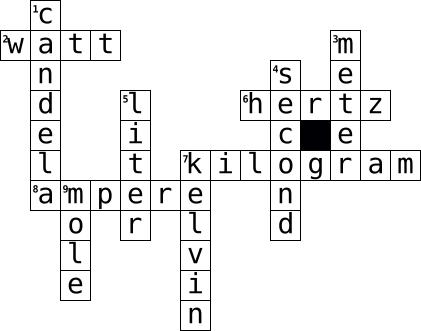
The Seven SI Base Units Explained
Let’s break down the backbone of measurement—the seven SI base units. These are the building blocks scientists lean on to keep everything precise, consistent, and universally understood. Each one ties into fundamental aspects of reality, stripped of guesswork or ancient artifacts. Here’s the lowdown:
Meter: The Unit of Length
Forget measuring sticks made of wood or metal. The meter is now defined by the speed of light—a constant zooming through a vacuum at exactly 299,792,458 meters per second. By locking length to this cosmic speed limit, scientists ensure every meter is precise and reproducible anywhere, anytime. From building skyscrapers to mapping distant planets, the meter helps us size up our world and beyond with confidence.
Kilogram: The Unit of Mass
The kilogram used to be a physical lump of metal sitting in France—a quirky relic prone to tiny changes. Now, it’s tied to the Planck constant, a fundamental number in quantum physics. This shift means mass isn’t based on “things” but on nature’s unchanging rules. Precision here cascades into industry, science, and even your grocery scale, making weight measurements steadier and future-proof.
Second: The Unit of Time
Time ticks with the rhythm of cesium atoms vibrating at ultra-stable frequencies. One second equals exactly 9,192,631,770 cycles of these atomic vibrations—like nature’s own ultra-accurate stopwatch. This atomic clock keeps the world’s time synced for GPS, internet, and daily schedules—because even a tiny hiccup in timing can throw off our tech-driven lives.
Ampere: The Unit of Electric Current
Electric current—the flow of electrons—is quantified by the ampere. It’s now defined by the elementary charge of an electron. Understanding and controlling this flow powers everything from your phone to industrial machines. Ampere keeps the electric pulse of modern life steady and measurable, making sure your devices get just the right juice.
Kelvin: The Unit of Thermodynamic Temperature
Kelvin measures temperature starting at absolute zero—the coldest anything can get, where atoms stop moving altogether. This scale is crucial in fields like physics and chemistry, where precise temperature control can mean the difference between breakthrough discoveries and failed experiments. Kelvin helps us chart the heat of stars and the chill of cryogenics alike.
Mole: The Unit of Amount of Substance
Counting atoms and molecules one by one would be impossible. Enter the mole—a clever way to bundle 6.02214076×10²³ particles into a manageable number. This unit simplifies chemistry and biology, letting scientists count out substances with confidence rather than guesswork. From pharmaceuticals to materials science, the mole bridges the microscopic and the measurable.
Candela: The Unit of Luminous Intensity
Candela measures the brightness of light as our eyes perceive it—not just raw energy output. This human-centric unit standardizes lighting technology—from street lamps to smartphone screens—so we can compare and design light sources fairly. Candela ensures that what looks bright to us is quantifiably bright, lighting up our lives with clarity.
Each base unit is a tribute to blending fundamental physics with practical needs. Together, they form the stable grid we rely on to explore, create, and understand the world—no sci-fi magic, just science fact.

Commonly Used Derived Units and Their Importance
Let’s talk about some of the everyday heroes of measurement: derived units. These are the units that build on the seven SI base units to describe quantities we encounter all the time. They might not get the spotlight like meters or kilograms, but without them, cooking dinner or powering your gadgets would be a total mess.
Liter: Volume Measurement
Think of the liter as the go-to for measuring liquids and gases. It’s simply 1,000 cubic centimeters—picture a cube that’s 10 cm on each side, filled with water, and you’ve got a liter. This unit shows up everywhere, from your fridge’s milk carton to the fuel gauge in your car. But watch out—liter isn’t an official SI unit, even though it plays nice with the system. And don’t mix it up with quarts or gallons; those are cousins from the imperial family and can trip you up if you’re not careful.
Watt: Power Measurement
Watt is the power player, literally. It measures how fast energy is used or produced, defined as one joule per second. When you glance at your phone charger or kitchen blender, watts tell you how much energy they gulp down or pump out. This makes watts crucial for everything from figuring out your electricity bill to designing high-efficiency solar panels. Knowing watts means understanding not just how much energy you have, but how quickly you’re burning through it.
Hertz: Frequency Measurement
Hertz counts how often something repeats in a second—cycles per second, to be exact. It’s the pulse behind sound waves, radio signals, and even how your computer’s clock keeps things ticking. When you tune into a radio station or check your Wi-Fi speed, hertz is silently doing the math to keep your devices in sync. It’s the heartbeat of modern communication and tech, turning frequency into something you can measure, control, and optimize.
These derived units might seem like second-string players, but they’re really the backbone of everyday science and technology. They bridge the gap between dry numbers and real-world action, helping us shape a smarter, more connected future.
Scientific Definitions and Everyday Importance of Units
When it comes to measurements, precision isn’t just a nice-to-have—it’s the backbone of reliable science and everyday life. The way we define units today ensures that no matter where you are on the planet, a meter means a meter, and a second always ticks the same. How? By anchoring these units to universal constants—things like the speed of light or atomic vibrations that don’t change with location or weather. This consistency allows scientists across the globe to compare results without confusion or guesswork, making international collaboration clearer and more effective.
But it’s not just high-tech labs that benefit. Think about baking your favorite recipe: knowing a kilogram isn’t merely a chunk of metal in a vault but a fixed number tied to nature lets you measure ingredients the same way every time. Energy bills? Watts help translate invisible currents into understandable costs, letting you track how much power your household gadgets use. Even health care leans on precise time and mass units when dosing medicine or timing tests—tiny differences can lead to big consequences.
Units are the quiet connectors that make global trade flow smoothly. When a shipment states 100 liters of a chemical, everyone knows exactly what that means—no surprises at customs or in the lab. That clarity spills over into technology too, where devices built in different corners of the world fit and work seamlessly because they “speak” the same measurement language.
So, units aren’t just abstract numbers—they’re the invisible thread weaving precision into our daily lives, science, and the global systems that keep everything ticking. Getting this part right means we can all trust what we measure, share, and create as we step boldly into the future.
The Evolution of Units of Measurement
Picture the world before standard units existed: a patchwork of local rulers, worn stones, or body parts stretched out to measure length. One town’s “foot” was another’s “handspan,” and trade was a wild guessing game. This wasn’t just inconvenient; it limited how people understood and shared knowledge. Science, engineering, and commerce demanded something better—a universal language of measurement.
The journey toward that universal language started slowly, with early attempts to standardize lengths and weights using physical objects, like metal rods or calibrated stones. But these artifacts were prone to wear, damage, or loss, causing inconsistencies. Imagine building a bridge or buying spices when your standard “kilogram” might be slightly heavier or lighter from place to place!
Fast forward to today’s modern definitions, where everyday objects have been replaced by the constants of nature itself. The meter, for instance, isn’t tied to a physical bar but defined by the speed of light—a cosmic speed limit constant everywhere in the universe. The kilogram has left behind its trusty platinum-iridium cylinder and now hinges on the Planck constant, a fundamental value in quantum physics. This shift moves measurement from fragile artifacts to stable, unchanging properties baked into the universe’s fabric.
By anchoring units to physical constants, we gain more than just reliability; we unlock precision at a previously unimaginable scale. Measurements can be replicated the same way in labs anywhere on Earth—or even beyond. The future of measurement is no longer tied to human-made objects but stands on the shoulders of nature’s most precise laws.
In essence, the evolution of units is a story of moving from guesswork to finely-tuned certainty—a leap that quietly powers science, technology, and everyday life in ways we often take for granted.

The Role of International Organizations
When it comes to keeping measurements consistent worldwide, there’s no room for guesswork or “close enough.” That’s where international organizations step in—think of them as the referees making sure the game is played by the same rules everywhere.
First up is the International Bureau of Weights and Measures, or BIPM (pronounced “bip-em”). This group is the global headquarters for all things measurement. Based in France, BIPM is the nerve center that defines and maintains the International System of Units (SI). They make sure that a meter in Tokyo is the same length as a meter in New York, and that a kilogram somewhere in Europe matches one anywhere else.
But BIPM doesn’t work alone. Each country has its own national metrology institutes—like the National Institute of Standards and Technology (NIST) in the US—that act as local hubs. These labs handle the nitty-gritty: they develop and test measurement standards, calibrate instruments, and serve as the trustworthy middlemen between BIPM’s global definitions and real-world applications. When a factory calibrates its scales or a lab verifies the accuracy of its instruments, it often turns to these institutions.
Together, BIPM and these national institutes form a seamless network, constantly collaborating to refine and improve how we measure everything from time to temperature. This isn’t just bureaucratic nitpicking—it’s the foundation for innovation, safety, and fairness in science, industry, and daily life. Without these organizations keeping measurements locked in place, modern technology and global trade would quickly grind to a halt.
So next time you glance at a stopwatch, fill up your gas tank, or trust the recipe’s teaspoon count, remember: there’s a global team working behind the scenes to keep those numbers exact, reliable, and future-ready.

Future Trends in Units of Measurement
We’re standing at the edge of a measurement revolution. As tech grows sharper and more precise, so do the tools that help us measure the world. Quantum and atomic technologies are leading the charge, promising levels of accuracy that once lived only in sci-fi pages. Imagine clocks so exact they could keep time with the tiniest vibrations of atoms—and sensors that detect changes so subtle, they make today’s instruments look clumsy by comparison.
But it doesn’t stop there. Emerging tech like the Internet of Things (IoT) and artificial intelligence aren’t just gadgets—they’re measurement game-changers. Smart devices can gather data around the clock, feeding a digital brain that sorts, analyzes, and adjusts in real time. This means meters, scales, and sensors will no longer just measure—they’ll learn, self-calibrate, and automate precision like never before.
As measurements become digital and interconnected, expect new units or revised definitions to follow. The focus? Stability, universality, and adaptability for a world that demands data you can trust, instantly. It’s a future where science and everyday life sync up seamlessly because measurements have leveled up, ensuring everything from energy grids to healthcare stays on point.
In other words, we’re heading into an era where measuring isn’t just about numbers—it’s about unlocking possibilities we’ve only just begun to imagine. The future’s units of measurement? They’re not just tools; they’re the silent architects of tomorrow’s breakthroughs.

Conclusion
Units of measurement aren’t just numbers on a scale—they’re the backbone of how we make sense of the world. From the meter that maps our cities to the second ticking inside our devices, SI units create a universal language for science and everyday life. Without them, precision would be guesswork, and global collaboration would falter.
But this isn’t a static story. Our understanding of units evolves as technology pushes boundaries. Redefining the kilogram by tying it to a constant of nature instead of a dusty old object? That’s progress. Using atomic clocks to nail down the second more precisely than ever? Even better. These changes are more than academic—they enable innovation, from smoother trade to smarter tech.
The journey toward ever greater accuracy is ongoing. As quantum advances and AI-driven measurements become the new normal, we’ll see units that are not just precise but seamlessly integrated into our digital, connected future. So next time you check the time, weigh your groceries, or charge your phone, remember: behind every reliable reading lies a carefully crafted standard, guiding us steadily into tomorrow.

References and Further Reading
Ready to dive deeper into the world of measurement? Here’s a curated list of authoritative sources that break down the science, history, and future of units — no PhD required.
-
NIST (National Institute of Standards and Technology)
The go-to spot for everything about units and standards in the U.S. Check out their clear guides and updates on SI units.
Website: nist.gov -
BIPM (International Bureau of Weights and Measures)
The global headquarters for measurement rules. Their site covers the official definitions of SI units and the latest redefinitions linked to physical constants.
Website: BIPM.org -
The SI Brochure
An official and detailed reference from BIPM, perfect if you want the full story on how units are defined and maintained worldwide. It’s technical, but easy to navigate for curious minds. -
Britannica – Units of Measurement
For a solid historical perspective and simplified explanations, this encyclopedic resource explains the evolution of measurement systems through the ages.
Website: britannica.com -
“The Measure of All Things” by Ken Alder
A fascinating read about the birth of the metric system during the French Revolution. It’s history meets science, showing how measurement shapes civilization. -
Science News and Popular Tech Sites
Keeping an eye on how quantum tech and AI are transforming measurement is easier with outlets like Science News or Wired. They regularly highlight breakthroughs that could redefine how we quantify the world.
Whether you’re a student, hobbyist, or just curious, these links offer a guided tour to the nuts and bolts behind the meter, kilogram, and beyond. Because understanding measurement isn’t just for scientists — it’s the language the future speaks. Ready to join the conversation?












-
 Jigsaw Puzzles
Trolltunga Abstract Jigsaw Puzzle 250 | 300 | 500 Pieces
Price range: kr 348,00 through kr 439,00 Select options This product has multiple variants. The options may be chosen on the product page -
 Jigsaw Puzzles
Majestic Stag Watercolor Jigsaw Puzzle 250 | 300 | 500 Pieces
Price range: kr 348,00 through kr 439,00 Select options This product has multiple variants. The options may be chosen on the product page -
 Jigsaw Puzzles
Twelve Zodiac Cow Ink Wash Jigsaw Puzzle 250 | 300 | 500 Pieces
Price range: kr 348,00 through kr 439,00 Select options This product has multiple variants. The options may be chosen on the product page